Keeley Tan Trading

Free practice challenge · 7 modules

Your first 100 trades, done right.

Take 100 trades on a simulator, on one simple setup, and find out from your own data what actually makes a trader profitable. No money, no pressure, just reps. Already finished the reading course? This is your next step.

Module 0: The Honest Deal

This is your bike with training wheels, not an edge. Read this module before anything else, because the framing is the whole thing.

Lesson 0.1: Read this first

Most trading courses open by selling you a dream. I am going to do the opposite.

You are not going to make money here. Not on this track. That is not what it is for.

This is your first 100 trades, taken on Replay, on one simple setup I am going to hand you. No real money. No pressure. The whole point is to get reps and learn how a trader actually operates, before a single dollar is on the line.

  • One setup. Simple, mechanical, easy to follow. You get it in Module 2.
  • One market, one timeframe, replay. You set that up in Module 1.
  • 100 trades. You take them, you journal every one, you review them.
  • Sim only. You are here to learn, not to earn.

That is it. No indicators to buy, no signals, no secret. Just reps. If you came for a strategy that prints money, this is the wrong door. And honestly, so is every other door, because nobody has one.

Lesson 0.2: The setup is not the edge

This is the most important thing I will say on this whole track. Read it twice.

The setup I give you is not the reason you will win or lose. It is a bike with training wheels. Its only job is to get you moving so you can learn to ride.

Here is the truth almost nobody tells beginners. Hand the exact same setup to ten traders and you get ten different results. Same rules, same chart, ten outcomes. One is patient, one is not. One waits for the clean version, one grabs the messy one. One sizes right, one panics. The setup is identical. The operator is not.

So the edge was never in the setup. The edge is in how you operate it: your patience, your discipline, your read of the context, the system you build around it over time. That part is yours, and that part is the work. This is why I will never sell you "my winning strategy." There is no strategy that wins on its own. There is only a person who has learned to operate one. That person is who you are here to become.

Lesson 0.3: How you win here

If money is not the scoreboard, what is? Reps taken to your rules. That is the whole game.

A trade where you followed your rules is a win, even if it lost money, because it gave you a clean data point. A trade where you broke your rules is a loss, even if it made money, because it taught you nothing and trained a bad habit. You will track this in your journal in Module 4.

Here is what I expect by trade 100: you will be somewhere near breakeven. Maybe a little up, maybe a little down. That is not failure. That is the lesson landing. When you finish 100 clean reps on a perfectly fine setup and you are still flat, you will understand, in your gut and not just your head, that the setup was never the thing. You will have proven it to yourself, with your own data.

And that is the door to what comes next. When the training wheels stop being enough, that is the full system course. But do not rush there. Do your 100 reps first. Earn the lesson.

Homework: Post in the challenge channel: your name, your one market and timeframe, and this line in your own words, "I am here for 100 reps, not a magic strategy." Saying it out loud is your first rep.
Module 1: Pick Your Sandbox

Before you take a single rep, you set up a clean place to take them. Two minutes, then you are ready.

Lesson 1.1: One market, one timeframe

Pick one market and stay on it for all 100 trades. The same market you used on the reading course is perfect. One market means you learn its rhythm instead of drowning in five.

Pin the daily chart, where one candle is one day. That is where you take all 100 reps. Do not hop timeframes looking for action.

One thing you will notice: in my walkthrough I show this setup on the 1-hour, but you are trading it on the daily. That is on purpose. It is the exact same shape, just at a different zoom, and seeing it on two timeframes proves the point of this whole thing: the pattern does not care about the timeframe. We use the daily because you can replay it on a free TradingView account, which keeps this free for you.

Here is why one market and one timeframe matters. Your 100 trades are going to become data in Module 4. If you change market and timeframe every day, those 100 trades are 100 different things, and a pile of different things teaches you nothing. One market, one timeframe, and the reps start to add up to a picture.

Lesson 1.2: No account needed, use Replay

You do not need a broker, or even a demo account. You are going to practise on TradingView's Replay tool. Replay lets you wind any chart back in time and play it forward one candle at a time. So instead of waiting weeks for setups to appear live, you scroll back, hit Replay, and step the chart forward until your setup forms. When it does, you take it. You get your first 100 reps on setups that have already happened, in a fraction of the time it would take live.

Create your free account through my link: sign up for TradingView. On the free plan, Replay works on the daily, which is exactly the timeframe you need here, so this costs you nothing.

Optional, for the keen: the free plan cannot replay intraday like the 1-hour. If you want to practise on the 1-hour the way I do in my walkthrough, TradingView's 30-day trial unlocks it, and the same link gets you $15 off if you ever keep a paid plan. Totally optional. The daily teaches you the identical setup.

No real money, ever, on this track. You are here to learn the setup and build the habit, not to earn. Replay takes the fear out completely, which is exactly what you want while your only job is to see the setup and follow the rules.

Homework: open TradingView, load your one market on the daily, and turn on Replay. Wind back a couple of years and practise stepping the chart forward one candle at a time. Then join the Discord challenge channel and post: "I am on [your market], daily, Replay." That is your start line.

Module 2: The One Setup

This is the setup you will trade 100 times. One setup, one direction, fully mechanical. Remember Module 0: training wheels, not an edge. Your job here is reps, not profit.

Lesson 2.1: The one line we add

On the reading course I told you to keep indicators off your chart, always. For reading a chart, that still holds. Here we add exactly one, and only as a reference: a moving average, set to 10.

A moving average is just a line that plots the average price of the last 10 candles. As new candles print, the line moves. That is all it is. It gives you a moving reference for one question: is price stretched away from its recent average, or has it pulled back to it? We do not buy because the line says so. It has one job here: to define the pullback and the reclaim in the setup below. Put the 5 and the 20 on too if you like, but every rule here hinges on the 10.

Lesson 2.2: R, in one line

R is your risk on a single trade, the distance from your entry to your stop. A 2R target just means you aim to make twice what you are risking, so a win is +2R and a loss is -1R no matter the size of your account.

Lesson 2.3: The setup, step by step

It only happens in an uptrend, and we only go long.

One note before the rules. You trade this on the daily. The example I show is on the 1-hour, on purpose, so you can see it is the identical shape at a different zoom. Read my 1-hour example, then go find the same thing on your daily. The pattern does not care about the timeframe, and that is exactly the point.

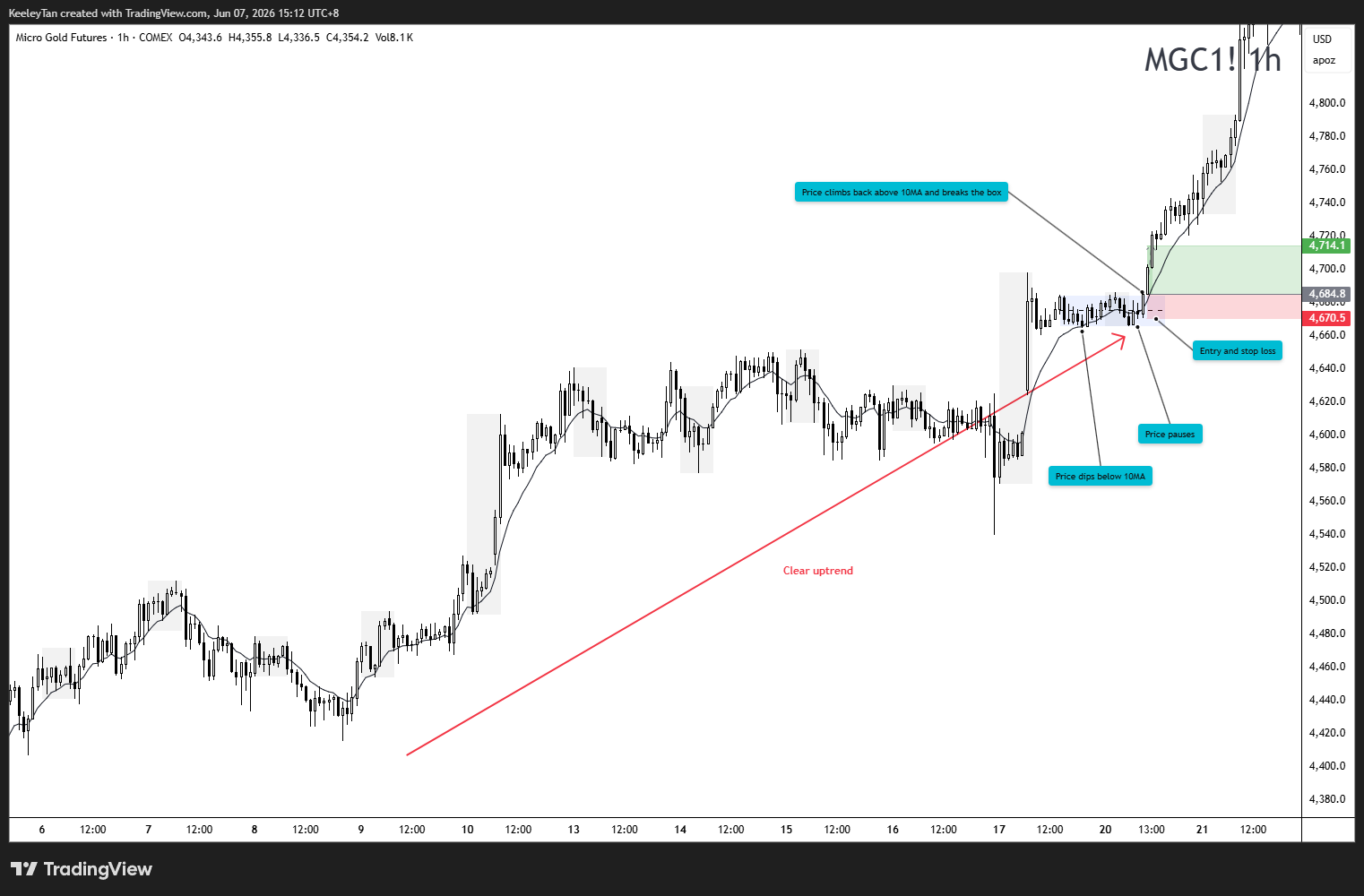
The story first, in plain words. Price is climbing. It makes a strong push up. Then it pulls back and dips below the 10 MA, which is normal, not a reversal. It goes quiet in a small tight range, a little box. Then it pushes back up, reclaims the 10 MA, and breaks out of that box. That breakout is your trigger.

  1. Market and chart. Your one market, the daily chart, with the 10 MA on it.
  2. Backdrop. A clear uptrend, higher highs and higher lows, that has just made a strong push up.
  3. Pullback. Price dips below the 10 MA.
  4. Pause. It stops falling and coils in a small tight box.
  5. Trigger. Price climbs back above the 10 MA and breaks out of the top of that box. That candle is your confirmation.
  6. Entry. Enter long when the breakout candle confirms.
  7. Stop. The low of that breakout candle. Back below it, you are out.
  8. Target. 2R. Measure entry to stop (1R), set your target twice that distance above entry, close there.
The pullback-reclaim setup on a 1-hour Micro Gold chart: a clear uptrend, price dips below the 10 MA, pauses in a box, climbs back above the 10 MA and breaks the box, with entry and stop marked.
The setup on the 1-hour. You trade it on the daily, but the shape is identical.

Lesson 2.4: Take the clean ones, skip the rest

A good one is obvious: a strong push, a clear dip below the line, a tight pause, a clean break back up. If you are squinting and arguing with yourself about whether it counts, it does not count. A skip taken on purpose is a winning rep too. You are not taking a hundred trades as fast as you can, you are taking a hundred clean ones and journaling every one.

Homework: on your one market and the daily chart, scroll back and find five clean past examples. Screenshot each and mark the push, the dip below the 10 MA, the box, the trigger, the stop, and where 2R would have been. Post them in the challenge channel.

Module 3: One R, And Honest Reps

This is the shortest module, and it is the one that makes your 100 reps worth anything. Two rules.

Lesson 3.1: Every trade risks 1R

You do not need to think about dollars or account size on this track at all. Every trade risks one R. R is the unit you met in Module 2: the distance from your entry to your stop. A winner that reaches your 2R target is +2R. A loser that hits your stop is -1R. That is the whole language.

The same 1R on every single trade. No betting more on the ones you like. The point of 100 reps is that they are all the same size, so the results actually mean something when you read them in Module 4. Trades sized by gut feeling are just noise. When to risk more than 1R is a real skill, and it lives in the full course, with real money, not here.

Lesson 3.2: Mark it with the tool, and do not fool yourself

You do not place live orders here. You mark the trade on the chart with TradingView's long-position tool: drop your entry, your stop at the trigger-candle low, and your 2R target. The tool shows you the 1R and 2R levels, so you can see exactly where the trade wins or loses.

Now the one that actually matters. The biggest mistake in Replay is playing the candles forward too fast and then making a hindsight decision. You let the chart run, you see where price went, and then you tell yourself you "would have" taken it, or you nudge your entry to where it should have been. That is not a rep. That is a fantasy, and it quietly poisons all of your data. So do it honestly. The moment your setup triggers, stop. Mark the trade before you step the chart forward one more candle. Then play it out, one candle at a time, and live with the result. Decide first, then watch. Never the other way around.

Lesson 3.3: That is the whole thing, for now

Two rules: every trade is 1R, and every trade is marked before you see what happens. That is all you need to make 100 clean, honest reps. The money side of risk, how big a real R should be once you have a proven edge, position sizing, the math that ends careers, is a whole module in the full course. You do not need any of it to take reps on Replay. You need it before real money touches the screen. One thing at a time.

Homework: post in the challenge channel: "Every trade is 1R, and I mark it before I play the candles forward." Saying it is your commitment to honest data.

Module 4: Journal Every Rep

This is where 100 trades stop being 100 clicks and become data you can actually learn from. The tool is the free journal, and the habit is logging every single rep, honestly.

Lesson 4.1: Get the free journal

Grab the free Trade Journal, the same one on my site and in your welcome email. Drop your email, get the sheet, make your own copy. You do not need every tab in it yet. For this track you need one thing: a row for every trade you take.

Lesson 4.2: Log every rep, win, loss, and skip

Every rep goes in. Not just the winners, not just the interesting ones. Every one. For each trade, log the basics: the date and market, whether the setup had its parts, your entry, your stop, your target, and the result in R, so +2R for a winner and -1R for a loss.

Then the column that matters most: did I follow my rules? Yes or no. A trade you took exactly to the rules is a yes, even if it lost. A trade where you jumped in early, moved your stop, or forced a setup that was not really there is a no, even if it won. And log your skips. A setup you correctly passed on is a rep too.

Lesson 4.3: Score reps, not money

Here is your scoreboard, and it is not your profit. Your score is the share of trades you took to your rules. A rule-following loss is a winning rep, a clean data point that cost you nothing real. A rule-breaking win is a losing rep, it taught you nothing and trained a habit you will pay for later with real money.

Track two numbers as you go: your rule-adherence percentage, the skill you are actually building here, and your running R. By trade 100 you will have a real data set on yourself, and in Module 6 we read what it is telling you. One rule above all of it: log it honestly. The journal is worthless the moment you fudge it. An honest losing rep is worth ten flattering lies.

Homework: log your first 10 reps in the journal, every one, with the rule-followed column filled in. Then post your rule-adherence count in the challenge channel, like "8 of 10 to the rules." That number, not your profit, is the one we care about.

Module 5: The 100-Trade Challenge

This is the work. Everything before this was setup. Now you go and take your 100 reps. Here is how to do it so you actually finish, and not alone.

Lesson 5.1: The challenge, in one line

100 clean reps. Your one market, the daily, the one setup, 1R each, every one journaled and scored on rule-adherence. That is the whole challenge. It is simple, it is not easy, and it is the most useful thing a new trader can do. Most people never take 100 honest reps of anything. You are about to.

Lesson 5.2: Do not do it alone

Doing this on your own is hard to stick with. So we do it together, in the Discord challenge channel. Once a week, post your update: how many reps you took, your rule-adherence percentage, and one thing you noticed. Read other people's, comment on a couple. There are markers along the way: 25 reps, 50, 100. The point is not speed, it is showing up and stacking honest reps where people can see you do it.

Lesson 5.3: How to not quit in the middle

I will be straight with you. The middle is boring. Somewhere around rep 30 or 40 the novelty is gone and the finish line is not close. That is exactly where most people drift off. Two things get you through. First, a cadence you can hold: pick a number of reps per sitting and a number of sittings a week, and protect it. Do not blast 100 in a day, you will get sloppy and learn nothing. Do not let it drag for a year either. A few honest sittings a week gets you there in a few weeks. Second, the channel. On the days you do not feel like it, the fact that people can see whether you showed up is worth more than any motivation. Post anyway.

Homework: commit to your cadence out loud in the channel, for example "15 reps a sitting, three sittings a week." Then go, and do not stop until you hit 25. Post when you get there.

Module 6: What Your Data Just Told You

You did the reps. Now we read them, and I show you where this goes. This is the most important module on the track, so do not skip it because you are tired.

Lesson 6.1: Read your own data

Open your journal and look at the whole thing. Here is what you will probably see. Your running R is somewhere near breakeven, a little up or a little down. The number that actually moved is your rule-adherence, hopefully climbing as you went. Your losses cluster in certain conditions. And your results do not match mine on the same setup, even though we ran the exact same rules. Sit with that for a second.

Lesson 6.2: The lesson, proven in your own hand

Near breakeven, on a fair setup, taken honestly, over 100 reps. That is not failure. That is the whole point landing. You knew it in Module 0, where I told you the setup was not the edge. Now you have proven it to yourself, with your own data, which is worth a hundred times more than me saying it. Same setup, two operators, different results. The setup was never the thing. The edge is the operator, you, and the system you build around the setup over time.

Lesson 6.3: What that breakeven setup can become

Now the part that should light you up. I took this exact setup, the one you just traded to breakeven, and ran the analyze-and-refine loop on it. I looked at where the winners clustered, I added a filter, I tested the exits. Raw, in your hands, it is roughly breakeven. Refined, it changed completely. It went from nothing to clearly worth trading.

I am not going to throw a big number at you, because a number is not real until it is proven across a full sample, and that proving is the entire point. Here is what I want you to take from your 100 reps: the breakeven setup is not a dead end. It is raw material. Learning to refine it into something that is actually yours, and proving it across enough trades to trust it with real money, is exactly what the next course is.

Lesson 6.4: Where you go from here

You can take a setup, follow your rules, journal honestly, and read your own data. Most people who have traded for years cannot do those four things. You just did them 100 times.

When you are ready to build a system that is yours and prove it properly, that is the full system course, Core Trading A-Z, and it is open now. Read first, rep second, build third. In that order, never skipping ahead.

Homework, and your graduation: post your 100-rep summary in the channel, your final rule-adherence percentage, your running R, and the one biggest thing you learned about yourself. Claim your 100 club spot. You earned it.

Stay consistent. Stay safe.

Start your first 100 reps

Open a free TradingView account, grab the free journal, and come into the Discord to take the challenge with everyone else.

Finished your 100 reps?

The next step is building a system that is actually yours and proving it with data. That is the full system course, Core Trading A-Z, and it is open now.

Education only, not financial advice. Practising on a simulator is not the same as trading real money.